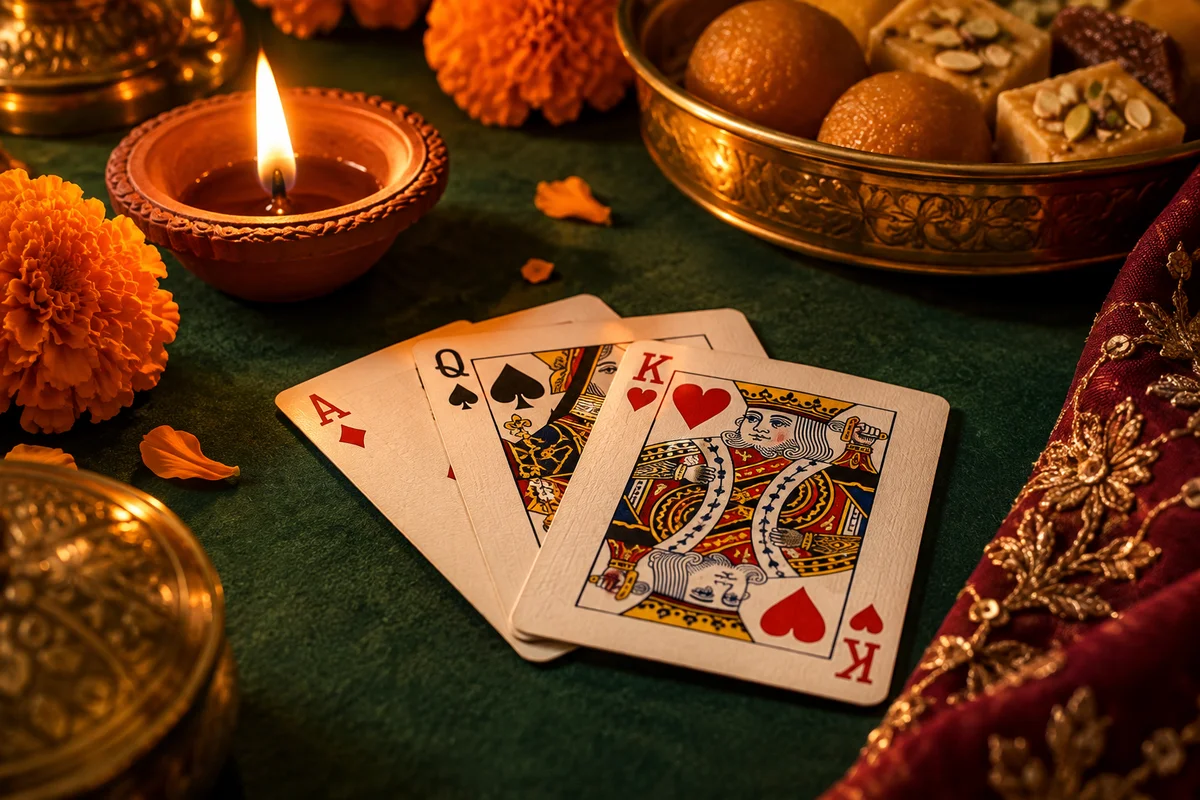
What you need for Diwali Teen Patti
Use a standard 52-card pack without jokers for basic Teen Patti, plus a score sheet or tokens with no cash value. Choose a dealer and deal three face-down cards to each player. Before starting, agree the hand rankings, tie rules and a maximum round length.
Teen Patti blind play and seen play
A blind player has not looked at the three cards. A seen player has. Traditional betting rules differ between the two, so for an introductory party version it is easier to use a fixed points allowance and explain the sequence of actions slowly.
Players can stay in the round or fold. A folded hand takes no further part in that round. Agree in advance how a final show is requested and who can ask for a sideshow; these details often vary between house rules.
Teen Patti hand rankings: the six categories
From strongest to weakest, the usual order is trail, pure sequence, sequence, colour, pair and high card. Agree how you will rank A–2–3 and A–K–Q sequences, and how equal hands are resolved. Do not assume every online version follows the same rules.
- Trail beats a pure sequence.
- A pure sequence beats a mixed-suit sequence.
- A sequence beats a colour.
- A colour beats a pair.
- A pair beats a high-card hand.
Diwali Teen Patti variations: Joker, Muflis and more
Joker, Muflis and other variations can alter the hand order or wild-card rules. Introduce them only once the group understands the basic game. Write the variation on a rules card so nobody discovers a different ranking after a hand is over.
No hand chart or staking system guarantees a win. For a Diwali party, equal starting counters and a fixed finish time are enough to keep the game enjoyable.
Common questions
What is the strongest Teen Patti hand?
In the usual ranking, a trail, meaning three cards of the same rank, is strongest. Confirm any house variations before dealing.
What is a colour in Teen Patti?
Three cards of the same suit that do not form a sequence.